Home › Blank Nutrition Facts label template
Blank Nutrition Facts label template
The current FDA standard vertical panel with blanks where the numbers go. Free to download and use, no sign-up.
Download it free
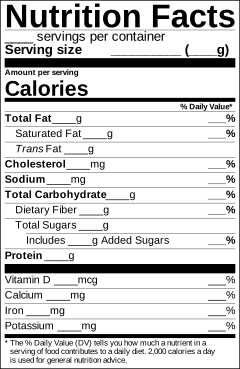
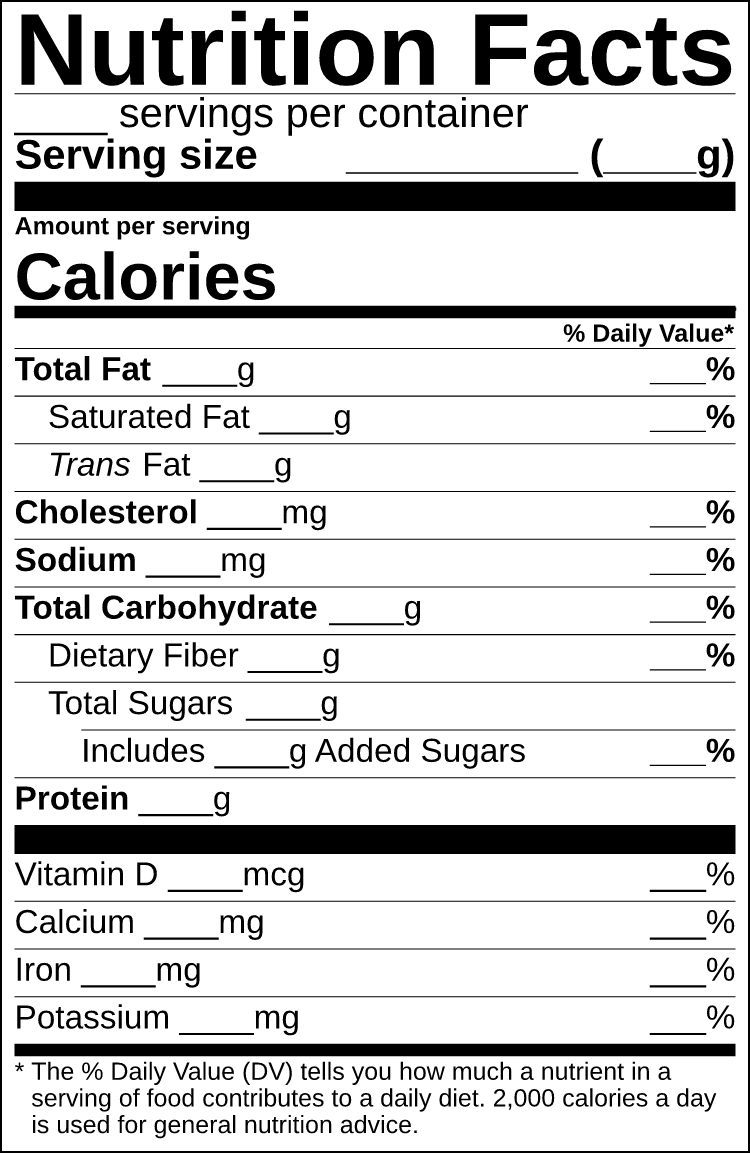
The PDF and SVG are vector files at print size, set in Liberation Sans Bold and Regular (the same widths as Helvetica and Arial), with the rule weights and type sizes of the FDA's graphic specifications for this format. Open the SVG in Illustrator, Figma or Inkscape to type over the blanks. The PNG is for quick mockups.
It follows the format in 21 CFR 101.9(d) for foods for adults and children 4 years and older, as revised in 2016: bigger Calories, Added Sugars with its own %DV, and Vitamin D, Calcium, Iron and Potassium as the required vitamins and minerals.
How to fill it in
Work out every number per serving first; the template only holds them. The order of the lines is fixed by the regulation, so don't move or drop any.
Servings per container and serving size
Write the number of servings, like "8 servings per container", or "About 8" if it's rounded. The serving size is a household measure followed by the weight in grams, like "1 cookie (30g)". The serving should match what people usually eat at one time; the FDA's reference amounts for each food category are in 21 CFR 101.12.
Calories
Round to the nearest 5 up to 50 calories and to the nearest 10 above that. Under 5 is written as 0.
Fat, cholesterol, sodium, carbohydrate, sugars, protein
Each nutrient has its own rounding rule. Fat, for example, is 0 under 0.5 g, rounded to the nearest 0.5 g below 5 g, and to the nearest gram from 5 g up; sodium goes to the nearest 5 mg up to 140 mg and the nearest 10 mg above. All of them are in the rounding rules table.
Added Sugars goes on the "Includes ___g Added Sugars" line, indented under Total Sugars.
% Daily Value
Divide the amount by the Daily Value and round to the nearest whole percent. The current Daily Values include 78 g total fat, 20 g saturated fat, 300 mg cholesterol, 2,300 mg sodium, 275 g carbohydrate, 28 g fiber and 50 g added sugars. Trans fat, total sugars and (usually) protein have no %DV, so those lines have no percent.
Vitamin D, calcium, iron, potassium
Write the amount (mcg or mg) and the %DV. Their percents round differently from the rest: to the nearest 2% up to 10%, 5% up to 50%, and 10% above that. The Daily Values are 20 mcg vitamin D, 1,300 mg calcium, 18 mg iron and 4,700 mg potassium.
The footnote
The footnote about the % Daily Value and 2,000 calories a day is already printed on the template. Keep it.
A blank template saves you the layout, not the work. The hard part is getting accurate numbers for each serving: adding up every ingredient, dividing by the batch weight after cooking, then rounding each nutrient by its own rule. The step-by-step guide walks through it with a worked example.
Using the template on your packaging
Print it at 100% or larger, never smaller. The type is already at the minimum sizes in 21 CFR 101.9(d)(1)(iii): 8 point for the nutrient lines, 16 point for "Calories" and 22 point for its number, 6 point for the footnote. Keep it all black (or one color) on white or another neutral background. Packages too small for this panel are allowed other formats, which this template doesn't cover. Next to the panel you still need the ingredient list in descending order by weight and, if any of the nine major food allergens is present, a "Contains" statement.
Rather not do the math?
Enter your recipe and LabelWhisk fills in this same panel for you, with the ingredient list and the allergen line.